
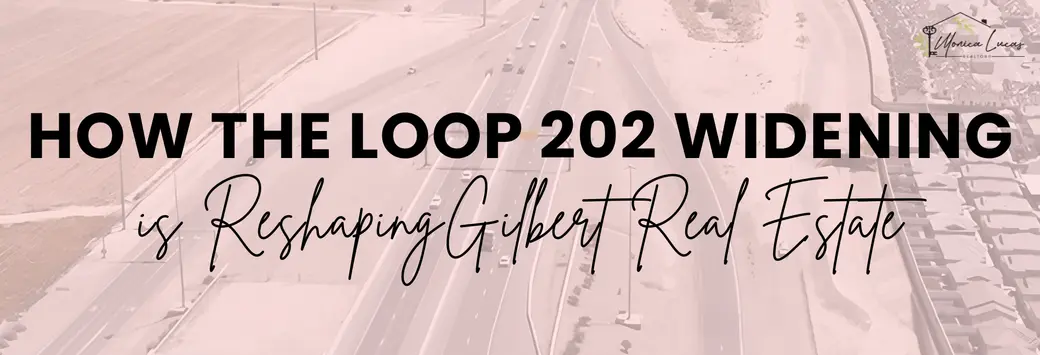
How the Loop 202 Widening is Reshaping Gilbert Real Estate
If you drive the Loop 202 through Gilbert or Chandler regularly, you've already noticed the construction. What you're watching take shape is one of the most significant infrastructure investments in the East Valley in years, and it has real implications for anyone buying, selling, or thinking about where to put down roots in the Phoenix Metro.
Here's what's happening, why it matters, and what it means for Gilbert real estate.
A Quick Background: What Is the Loop 202?
The Loop 202, known as the Santan Freeway in the East Valley, is the primary ring freeway connecting Gilbert, Chandler, Mesa, Tempe, and South Phoenix. It's the freeway backbone most Gilbert residents rely on every single day.
The South Mountain segment opened in December 2019 as the largest infrastructure project in Arizona state history, completing the ring around the southern edge of the Phoenix Metro and allowing East Valley drivers to bypass downtown Phoenix entirely. But with the East Valley's population continuing to surge, demand on existing lanes quickly outpaced capacity. That's where the current widening project comes in.
What the Widening Project Actually Involves
The Loop 202 Santan Freeway widening runs from Loop 101 to Val Vista Drive in Chandler and Gilbert, adding two lanes in each direction between Loop 101 and Gilbert Road. The total investment is approximately $200 million, funded through Proposition 400, Maricopa County's half-cent sales tax dedicated to regional transportation.
Construction is active throughout 2026, with the project on track for its 2027 completion.
What It Means for Commute Times
The commute impact is straightforward and tangible.
Gilbert residents currently face regular congestion on the Loop 202 during peak hours, particularly along the Loop 101 to Gilbert Road stretch. Adding two lanes in each direction does several meaningful things:
- Increases overall freeway capacity, reducing bottlenecks
- Improves merging conditions at high volume interchanges
- Supports the growing number of reverse commuters traveling eastward into Gilbert's expanding job base
- Gives drivers more routing flexibility during incidents or peak congestion
Gilbert's mean commute time currently sits at about 26.1 minutes, compared to Chandler's 24.2 minutes. That gap, already modest, is likely to narrow further once the widening is complete.
What It Means for Gilbert Home Demand
Commute time is consistently one of the top three factors buyers cite when choosing where to live. When freeway access improves, the neighborhoods that benefit most tend to see increased buyer interest and upward pressure on home values. A few specific dynamics worth understanding:
- Neighborhoods near Loop 202 interchanges become more attractive. Communities in south and west Gilbert within easy reach of the corridor benefit most. Buyers who previously ruled out certain Gilbert neighborhoods due to commute concerns may reconsider once travel times improve.
- The freeway improvement compounds Gilbert's existing advantages. Gilbert already offers top-rated schools, low crime, and a high quality of life. The Loop 202 widening removes one of the few friction points that pushes some buyers toward Chandler or Mesa instead.
- Investors and developers follow infrastructure. Large infrastructure investments reliably attract commercial and residential development along surrounding corridors. Expect continued development interest along Gilbert's western edge as the project nears completion.
What's Coming Next: Beyond the 2027 Widening
The 2027 completion is one chapter in a larger regional infrastructure story. Under Proposition 479, Phase I projects include $1.26 billion to construct the new State Route 30 (Tres Rios) Freeway from Loop 202 to 97th Avenue, with construction starting in summer 2027 and finishing around 2030. An additional $131 million widening of Loop 202 between Loop 101 and I-10 is also planned.
The regional freeway system around Gilbert will continue improving well beyond 2027, and that sustained investment is a long-term tailwind for East Valley real estate.
What Buyers and Sellers Should Know
If you're buying in Gilbert: Buyers who purchase in freeway-adjacent neighborhoods before the project completes are positioning themselves ahead of the access improvement rather than paying a premium for it after the fact.
If you're selling in Gilbert: The widening is a legitimate selling point for buyers who commute to Chandler, Tempe, or Phoenix. A $200 million freeway investment finishing in 2027 adds a strong forward-looking narrative to your home's location story.
If you're comparing Gilbert to neighboring cities: The widening directly addresses one of Gilbert's few commute disadvantages relative to Chandler. Once complete, it strengthens Gilbert's already compelling case as the premier place to live in the East Valley.
The Bottom Line
The Loop 202 widening is a $200 million investment in the freeway Gilbert residents use every single day, and it's finishing in 2027. Better commutes, improved connectivity, and sustained development interest along the corridor are the direct results. For anyone making a real estate decision in the East Valley right now, this project is part of making a fully informed choice.
Questions about how the Loop 202 widening affects specific neighborhoods or your buying and selling strategy? I'd love to help. Reach out anytime.
Freeway project details sourced from Arizona Department of Transportation (azdot.gov), Daily Independent, AZBEX, and Maricopa Association of Governments. Real estate market data sourced from publicly available sources as of Q1 2026. All figures and timelines are subject to change. This post is for informational purposes only.
Categories
Recent Posts